Showing posts with label ritual. Show all posts

Monday, 7 December 2015

Winter drawers on

Winter drawers on, as Terry Wogan used to say on his morning radio programme. The nights are drawing in. The days are dim, the nights are dark.
“Dark” is a curious word. It has two different but related meanings. It can be the mere absence of light. Nothing changes when we turn off the light – no scary ghosts, no monsters under the bed. That's just our imagination.
Or is it? Most break-ins occur under cover of the night. The darkest deeds are done in the blackness of night. Who knows who, or what, is lurking in the shadows. We can't see what's there. And that is the second shade of meaning of the word “dark”: unknown. Sinister connotations are never far off. In The Lord Of The Rings we see the Dark Lord, and in Star Wars there is the dark side of the force. How hard it must be for a sightless person to understand.
The dark side of the moon is not unlit, but unknown to us because it is always turned away from the Earth. The Dark Ages refer to the 5th – 10th century following the decline of the Roman empire, a time with little recorded history. The Dark Continent, Africa, is obviously very sunny and bright, but was for many years unexplored. “He's a dark horse” they say. (My Aunty Eileen once said that of me)! That is a horse whose sire and dam are both unknown. ["Pierce Egan's Book of Sports," London, 1832].
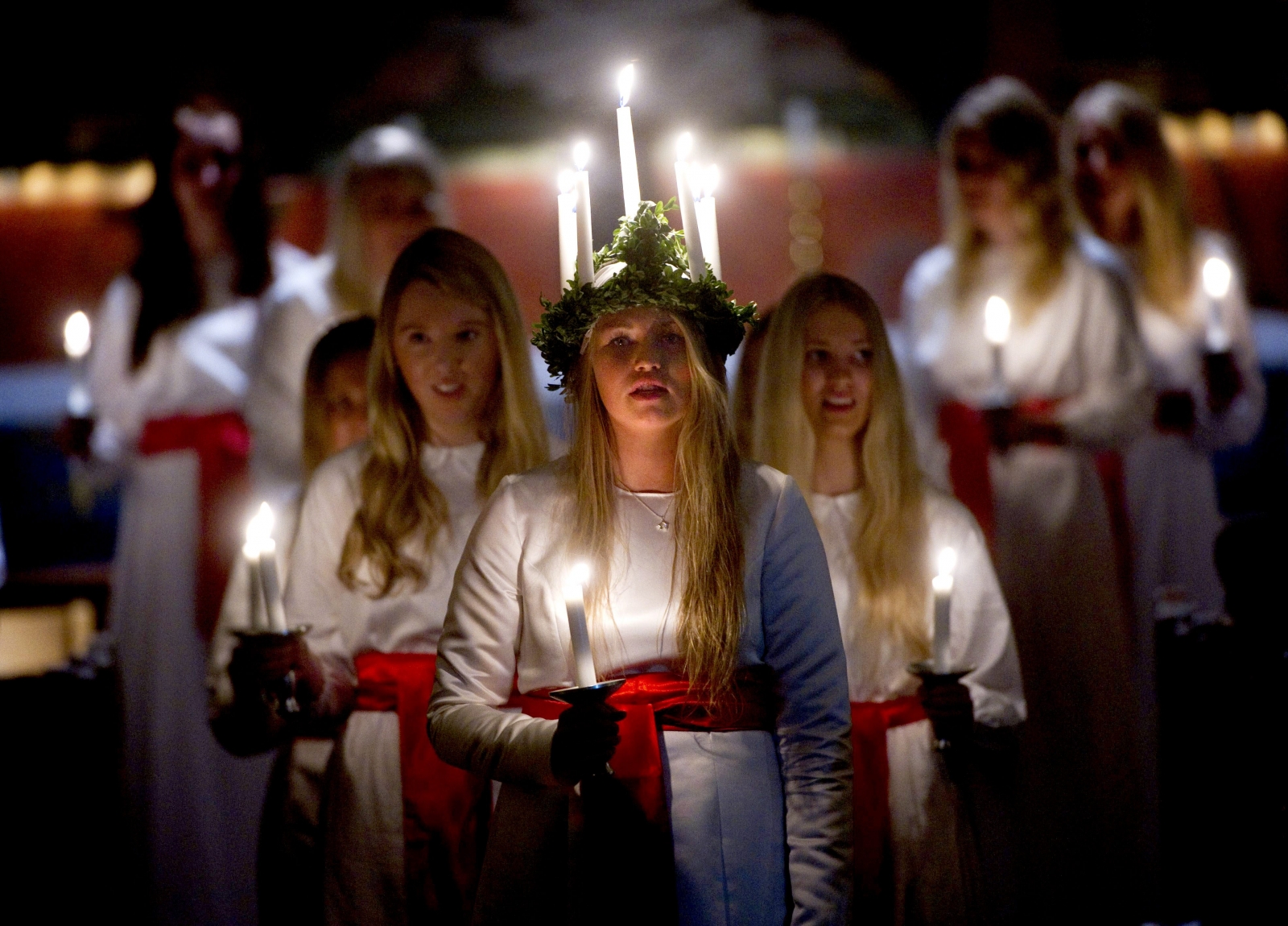
Amanda Lindblom performs as Santa Lucia during the traditional Queen of Light procession Varfru church in Enkoping, SwedenGetty


The light of the world (http://scpeanutgallery.com/)

After the Dark Ages came the Enlightenment. We could all breathe a sigh of relief – the lights are back on. There is a light at the end of the tunnel. As the year turns upon the solstice we celebrate the return of the light: In Sweden the festival of Santa Lucia (see my website for a video); in the Jewish tradition Hanukkah; In Holland, St Martin's Day; In Thailand, Loi Krathong; Diwali in India; and many others including Guy Fawkes night in England, but most notably Christmas in the Christian world. St John's Gospel says: “The light shines in the darkness, and the darkness has not overcome it.”
Many of those brought back from death by doctors (not just Christians) describe meeting Jesus as a bright light: the light is Jesus and the light is love. Perhaps somewhere deep in our hearts we know and love that light and long to return to it. Could this be the reason why we hate the dark?
May you have a brilliant Christmas.


Friday, 16 October 2015

Pippin's Oath

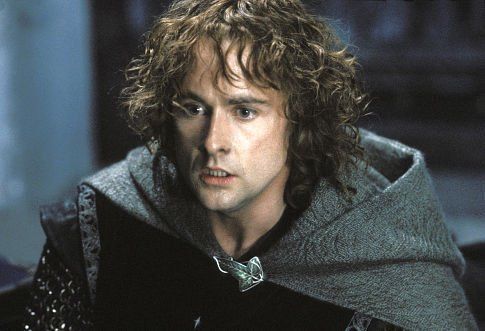
In "The Lord Of The Rings" by JRR Tolkein, a young and empty-headed hobbit called Pippin does a brave thing. As the last of the old kingdoms of men and of elves rally together for a last desperate stand against the overwhelming forces of darkness led by the dark lord Sauron, Pippin swears allegiance to Denethor, Steward of Gondor, the ancient stronghold of the kingdom of men. It is a gesture of courage and honour, in which he pledges his life for the land of Gondor, and so becomes a hero. Here, on the left, is his oath, and on the right the marriage vow of the Church of England.

“Here do I swear fealty and service to Gondor,
and to the Lord and Steward of the realm,
to speak and to be silent,
to do and to let be,
to come and to go,
in need or plenty,
in peace or war,
in living or dying,
from this hour henceforth, until my lord release me,
or death take me, or the world end.”
“I,....., take you,.....,
to be my wife,
to have and to hold
from this day forward;
for better, for worse,
for richer, for poorer,
in sickness and in health,
to love and to cherish,
till death us do part;
according to God's holy law.”

The similarity is no coincidence. Marriage is rightly a happy time, but underneath the brilliance of flowers and confetti lies an ancient and solemn act of heroism. Each of the partners pledges their life to the other, to stand by them through thick and thin, and implicitly to die for them if necessary. By taking this oath they become more than they are - they become heroes. And their marriage becomes more than the sum of its parts, it will be the kingdom in which they will live out their lives.

Monday, 9 February 2015

You are HERE...

This is a diagram showing where we are in relation to everything.

Our civilised daily lives are built on the foundation of our religions, laws and customs. These in turn are derived from our shared sense of values, which arise out of our still evolving mythology. And this was born out of our connectedness with Nature, the seasons, life and death.

If we start undermining our religions and laws, if we trash our values for quick profit, if we fail to understand or recognise our own mythology, if we lose our connection with the Earth, then the whole edifice will collapse.

This system is only held in place by a transcendent sense of the divine, the timeless, the ineffable, or as Wordsworth put it, the "sense of something far more deeply interfused, whose dwelling is the light of setting suns and the round ocean and the living air and in the mind of man."

Tuesday, 13 January 2015

What a celebrant does

You are a child of the Universe,
No less than the trees and the stars,
You have a right to be here.
       (Desiderata, Max Ehrmann)


When the Ancients lay on the cool ground at night, looking up at the stars, which encrusted the heavens like an unfolding glittering white cloth, they liked to imagine patterns like the join-the-dots pictures you may have drawn when you were a child. Some of these they named after animals – the Great Bear, the Swan, the Scorpion; some were characters from story – Hercules, Cassiopeia, Cepheus.

In reality these are not groups of stars at all. They just look that way from Earth. But we could equally group them in different ways if we wanted. We could have the Fork-lift Truck, the Harley Davidson, Tower Bridge. Seeing patterns in things comes easily to us. This is how we make sense of the world, of history, of our own lives.

As with the stars, we don't have just one story to tell. When we write a job application we will include everything about our education, our relevant experience and our positions of responsibility. But we probably won't include the way we struggled with bullying at school, or the dedication and love of our parents. We won't include the one we love, and the day we first met. Yet these things also have their story, and they are more a part of us than our position at work.

While our mundane life plods on from education to qualification to position to promotion to retirement to death, inside we are super-heros on a great adventure. We face danger, injury and disease; we see friends and family through life and death; we witness the miracle of birth; we struggle with our weakness as much as with our greatness. Against all the odds we triumph.

This is our brilliant human existence. It is a story written in the stars, waiting to be told. Who will tell our story? Or will it be buried with our bones? The skill of a celebrant is to recognise you as a child of the Universe, no less than the trees and the stars, your life unfolding like a cloth of silver.

With each turn of life there is a death and a rebirth. When we are born, the waiting is over, the period of pregnancy ends. It is a joyful beginning, but there is also a sense of loss; ask any mother. We cross a threshold into the unknown. And so at each new stage of life: starting school, starting secondary school, leaving home, starting work, giving vows, - right through to retirement, each milestone a new beginning.

A celebration can be seen as a snapshot pasted up onto the storyboard of our life, recording each stage as we go through. But there is more to it than just this. Imagine for a moment that you finally worked out for yourself how space and time was really structured, an understanding that would end a hundred years of speculation. Naturally you would want to tell the world. Why? Because until you do, to all intents and purposes, it hasn't happened. Unless you share it, it is just something in your head. Likewise a ceremony actualises reality – it makes reality happen.

In the Jewish tradition, a statement can occur on three levels: the first is a thought – even a thought is an action; the next is the spoken word, which is more powerful than just a thought; the most potent of all is the deed. In business, a handshake, or in previous times a kiss, seals a deal. Wearing the ring seals the marriage. A ceremony binds an idea into fact.

A qualified celebrant can work with you to make a ceremony that is right for you where you are in your life, that says what you want to say, that has the right feel. It can combine words, music, light, colour, costume - plus doves, balloons, fireworks, anything! Or just a few well-chosen words in a solemn setting. It's your call. You matter.

Wednesday, 30 July 2014

Boyhood


Last week I went to see Richard Linklater's epic film Boyhood. If you like action adventures, don't go. I loved it to bits.

Nathaniel, writing in TheFilmExperience.net says this:
Boyhood is less about its narrative than the experience of making one's own story through living, romanticizing, examining and sometimes confronting life itself.
Making ones own story. We can find ourselves wasting our lives trying to get a walk-on part in someone else's story when in reality we are starring in our own show right now, just like Truman in The Truman Show. We are real, but only when we are not playing a part.

We should be celebrating at every twist and turn because this is our life. We are not waiting for it to start, we cannot disown the bits we don't like, they are all what we are.

There is a beautiful scene in Boyhood, where the boy Mason's Mum casually advises an immigrant labourer to go to evening classes and learn English because he deserves better in life. Years later she is served by him in the restaurant he now manages, having gone to class and made good. She is struck speechless. She realises that in her preoccupation with her career and her relationships, much of her life has gone by unnoticed.
"You know what I'm realising? My life is just going to go. Like that. This series of milestones. Getting married. Having kids. Getting divorced. The time that we thought you were dyslexic. When I taught you how to ride a bike. Getting divorced... again. Getting my masters degree. Finally getting the job I wanted. Sending Samantha off to college. Sending you off to college. You know what's next? Huh? It's my fucking funeral!"
It has been said that life is what happens while you are making your plans.

We should all celebrate the life we have. It may not be exactly what we wanted, or what we were expecting, but it is ours and it is precious. One day our story will end. May it be a good story. May it have a happy ending.

Wednesday, 23 April 2014

Book Review: Passages Of The Soul

Passages Of The Soul: James Roose-Evans, Element Books, 1994

The title of this book refers to the transitions, or passages, that occur between the various phases of ones life, and the fact - as stated in the cover notes - that "in our modern world... our own celebration of these fundamental events often amounts to no more than brief, superficial ceremonies", if they happen at all, which in most cases they don't. The author holds that "ritual is an essential part of a balanced, meaningful life".

Roose-Evans, now 86, was a theatre director of some renown with a number of impressive productions, initiatives, books and collaborations to his credit. In this book he writes about his experiences working mainly with young actors and dancers coming through their education in the USA of the 50s and 60s. 

In the opening chapter he sets the stage, drawing on the ideas of Carl Jung, Joseph Campbell and Meister Eckhart. The inner world is just as real as the outside world. "If we are in Tao - that place where all opposites are united - we have an inexplicable effect on our surroundings." This is all good stuff, which fills the reader with excitement and anticipation as he turns to chapter 2.

This is where it all falls down. The whole of the rest of the book is concerned in one way or other with exercises in self-expression for those in the performing arts. Roose-Evans, an inveterate man of the theatre, has fallen into the trap of mistaking theatre-land for the real world. The groups participating in his sessions are required to make meaningful gestures in a rope circle, to spontaneously express their feelings using only their hands or by carrying a bundle of bamboo canes and dropping them. We are told in ecstatic terms of how a singing group established a rapport with a remote African tribe by singing "ah" very loudly. For actual or aspiring performers this must surely be gripping stuff; for the rest of us, the most we can hope for is a fascinating insight into the thespian mentality.

If this had been intended as a primer in expressive dance it would have been a success. Since it set out to be about rite-of-passage rituals it has entirely missed its purpose. We read that you can't just make up a new ritual, that it has to arise from the collective unconscious to be truly meaningful. There follows a list of made-up rituals, some improvised. Roose-Evans seems oblivious to his own pomposity. He tells of how a woman once told him she was going to use his ritual in her workshops: "I was struck speechless because it is an exercise that requires handling with skill and sensitivity".

In fact there are sections and paragraphs here and there that on their own make the book worth looking at for anyone trying to make sense of life. If my criticism is harsh it is only through disappointment; it could have been so much better.

Thursday, 10 April 2014

Time Out

Quite recently I attended a funeral for a civic dignitary. The service was exactly what you would expect from the Church of England at its best: a big congregation, organ, hymns, priests, prayers, fulsome praise from family and colleagues. The one whose loss they mourned was a true individual, the kind they don't make any more.

The last few weeks I have been reading, writing thinking and talking about funerals as part of my study to become an independent funeral celebrant. Of late I noticed that on social occasions I would have nothing to say, and end up staring blankly into the distance, as if the whole scene was one I had watched so many times already that I had got bored with it.

By yesterday afternoon I had had enough. Death is like an insidious grey fog that creeps silently over the landscape of your mind, gradually thickening and cutting you off from other people, leaving you alone with your grey thoughts.

It's true that in confronting death you find life, and know it for the first time. But my advice would be this: having found life, hold fast to it.

I do not for one moment regret my decision to embark on this course. Being a funeral celebrant is a huge privilege. To bring comfort to the bereaved, to honour the life that has now gone out, to be the one to commend that soul to God, to eternity, to our memory, is to be human at a level of reality that is beyond the reach of most mortals. I will walk over fire and water. I will go up to the mountain.

But I will also celebrate life, in all its hope and fear, all its richness and trouble, all its beauty.
I hope you never fear those mountains in the distance
Never settle for the path of least resistance
Living might mean taking chances
But they're worth taking
Loving might be a mistake
But it's worth making...
And when you get the choice to sit it out or dance
I hope you dance
(Songwriters: SANDERS, MARK DANIEL / SILLERS, TIA M.
I Hope You Dance lyrics © Universal Music Publishing Group, Sony/ATV Music Publishing LLC)

In his book "Passages of the Soul", James Roose-Evans says:
We have no rituals for pregnancy, for a miscarriage or still-born child, for a broken marriage, relationship or home; none for a girl's first menstruation, or a boy's coming to puberty; none for the elders of our society. We have let ritual - its power and vitality, its deeper value and significance - almost disappear from our lives.
My task, as I see it, is to put it back again.

Wednesday, 5 February 2014

5/02/2014 From ghoulies and ghosties

From ghoulies and ghosties and things that go bump in the night
Good Lord deliver us.
(Traditional)

One of my brother's friends had a case of things going bump in the night. Doors slamming, to be precise. There was no rational explanation. Other things happened. Very often the kettle would turn itself on at the electric point. Objects were moved from one room to another. Things became worse as he was about to take a contract in Holland. Something had to be done.

Following a recommendation, he travelled to see a specialist in hauntings. The medium didn't even have to visit the property; she told him the whole story of a woman deserted by a lover who had promised to return but never did. This ghost had now formed an attachment for my brother's friend, and didn't want him to leave. So the medium arranged for spirit 'on the other side' to provide a safe escort to enable the ghost to move on.

This is all a lot of tosh, right? There are no such things as ghosts. What you see is what you get. Ghosts are for the gullible.

Maybe.

But the doors never slammed again, and the kettle stayed off.
Not the house I stayed in
I have stayed in a house that seemed perfectly normal in every way. On the semi-basement level there was a dining room and kitchen, and a door to the back garden. On the other side of the stairway was the playroom. The odd thing was that no-one ever played there. In fact, no-one went there at all, unless they had to get something. The other odd thing was that you didn't linger on the stairs outside that room. You got up those stairs as fast as possible. You didn't spend much time alone in the dining room either, but if you had to, you stayed on the side away from the playroom. There was no story to explain all this; that was just how it was.

A recent lottery winner had dreamed of winning, every night for a week, before he won.

There are many accounts of Aboriginal Australians suddenly leaving on foot with the words "My brother is sick. I must go to him", and returning after three months having walked 500 miles, tended the brother, and walked back.

Whole books have been filled with real-life stories like these. You'd think we would learn. How many trees do we need to count before we see the wood?

Human life is not grounded in facts or in science, although we are rather good at it. We live on another level, the realm of feelings, emotions, courage, belief, love, sensitivity  - the list goes on - but we don't learn these things on the national curriculum. What we are taught is that none of them exist, and so all our humanity is squeezed out of us until nothing is left but this shell we call a body.

What we need is more mystery. We need ceremonies and rituals for all significant occasions in our lives, from being born, being named, coming of age, and so on right through to death and burial. These rituals will link us to one another, our history and our future, to the earth and the stars, to all of our hopes and fears, to the one life that lives in everything for all time and beyond time. This is what it means to be alive. To be really alive.